When does art find its final shape?
Finishing an illustration can feel strangely personal. You reach the point where it would probably look ‘done’ to everyone else, but you’re still circling it, zooming in, nudging a line, softening an edge, then undoing the whole thing because you’ve pushed it too far. If you draw or paint, you’ll know that moment when you think one more change could nail this, or become the proverbial kiss of death.
Within Your Heart took me right through that.
I started with one clear image in my head, a woman walking away from the viewer, with a cat beside her. That was my anchor. I didn’t want her looking back. I didn’t want a posed figure. I wanted forward movement, calm, and a sense of deep companionship. The cat had to feel alert and present, like it was tuned into her pace and mood because Within Your Heart is about the bond between human and feline that remains even after the kitty has passed on.
My first drafts were ink-based, influenced by Japanese art with sumi-e ink and brush. At the time, I was drawn to the restraint. Ink makes you commit. There’s nowhere to hide. You’re dealing with line weight, spacing, balance, and the pressure of your hand. My early sketches helped me lock in the posture of the figure, or so I thought, the fall of the sleeves, the direction of the walk, and the way the cat added to the scene without becoming a prop.
More atmosphere
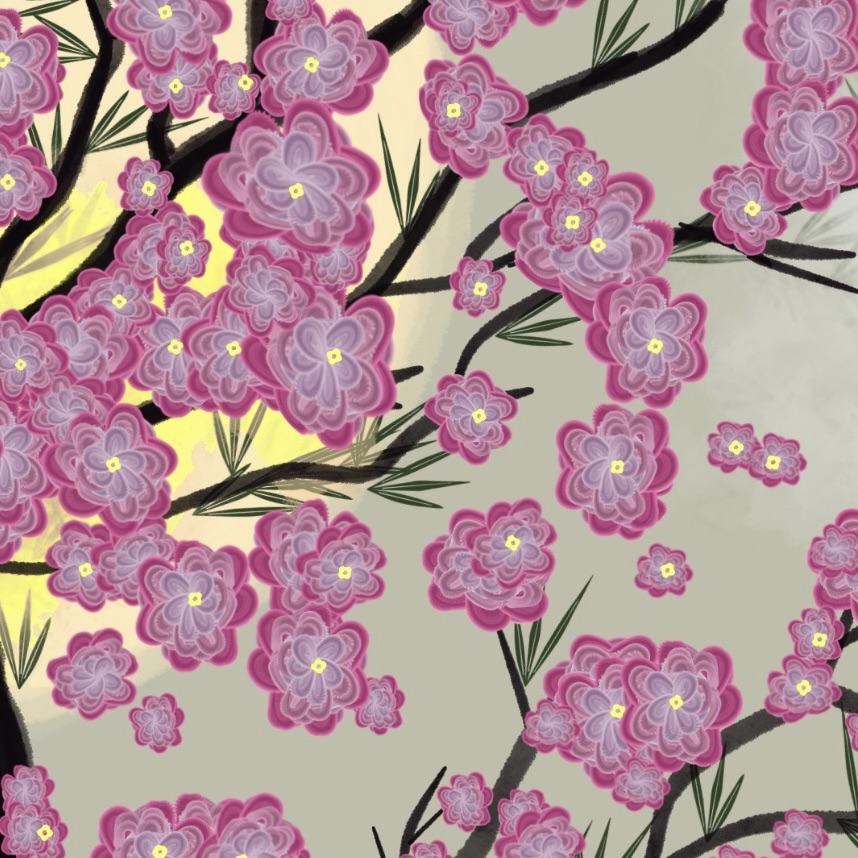
As I kept working, the illustration started asking for more atmosphere. I wanted the piece to carry warmth and season, without turning it into something too busy. That’s where the cherry blossoms came in. I wanted a way to give the composition a frame that would bring softness, and also a sense of time passing. The cherry blossoms also helped me balance the image.
Colour
Colour came in gradually. I didn’t intend for the kimono to be patterned. I just wanted a soft wash of colour, but as the piece evolved, so did the kimono. I kept coming back to pink because it felt calm and steady. It brings warmth, and harmonises well against the soft grey-green background. The patterning stayed fairly controlled because I didn’t want the surface detail to take over. I wanted the figure to be first, then texture and ornament afterwards.
If the shapes don’t ‘read’ right
The practical side of this piece involved plenty of back and forth. I tried versions that were too stark, then ones that felt overworked. I adjusted the blossoms again and again, their scale, their density, how far they drifted across the sky. I tweaked the linework so the figure stayed elegant without becoming stiff. I spent longer than I expected on the bow and the folds because cloth can look wrong quickly if the shapes don’t read right. The cat needed attention too. A cat can look flat in silhouette if you don’t get the stance right. That small curve in the back, the position of the legs, the tail angle, those things make the difference between ‘cat’ and ‘shape’.
Stop trying to solve everything
In the end, the piece came together when I stopped trying to solve everything at once. I focused on what mattered, the walk, the implicit bond between woman and cat, and the feeling of moving forward through a soft, blossom-filled space. Once that was clear, the rest became a series of smaller decisions rather than one big struggle.
The finish line
If you’re an illustrator, you’ll probably recognise the trials and tribulations of getting past the real finish line. It’s the point where you’re happy (mostly).
But if there’s one thing I know personally, it’s that I’m never really at the finish line because my critical eye never rests. I can still see many different ways to improve or pivot the piece. But is that really my critical eye, or just self-doubt and fear of being judged? It’s exhausting at times.
Why we doubt
There’s a reason why artists doubt their work even when it’s finished, making or creating anything exposes us to judgement.
I also think that when anyone works on a piece for a long time, they don’t just see paint or line anymore. They see every decision they hesitated over. They remember the moment they weren’t sure what to do next. The finished artwork carries the memory of uncertainty, even if no one else can see it. Viewers meet the work as a whole. The artist meets it as a trail of choices.
Technical confidence
There’s also a psychological gap between ability and expectation. As artists, our taste often develops faster than our technical confidence. We can sense what we’re trying to achieve before we’re fully able to make it happen. The work may be as good as we can make it right now, but it still feels slightly short of what we imagined. That doesn’t mean the piece is weak, it just means the artist is growing.
From analysis to acceptance
Doubt is also tied to how the brain processes creative effort. When you focus for long periods, your mind becomes attuned to errors and inconsistencies. This is useful while you’re working, but unhelpful once the piece is complete. The brain stays in problem-solving mode, scanning for what could be fixed, even when nothing really needs fixing. To let go, we have to shift from analysis to acceptance, and that is not easy.
Facing the risk
There’s a more vulnerable layer too. Art is rarely neutral to the person making it. Even when a piece isn’t autobiographical, it reflects taste, values, sensitivity, and attention. Finishing the work means letting it be seen, and being seen always carries risk. I think doubt is a kind of protection, a way of holding on to the work behind the scenes a little bit longer, before it has to face the world.
Many artists also struggle because finishing doesn’t bring closure in the way we expect. There’s often relief, but also a kind of emptiness. The intense focus ends, the adrenaline drops, and what’s left can feel flat. In that space, that’s where doubt can go into overdrive.
Over time, most artists learn that doubt is part of the creative cycle. It appears when we care a lot, and when the work has to move from private to public. A piece can feel finished when we know we can’t take it closer to what we imagined at the start, at least not today. Sometimes you sense that one more tweak would be the kiss of death, and the smartest choice is to stop, save, and step away.
Time and distance
With time and distance, something shifts. The emotional charge fades, and the work becomes what it is, a record of attention, effort, and choice at a particular moment in time. Often, that’s when artists can finally see their work with the generosity they offer to others.
Anyway, that’s where Within Your Heart ended up, and I’m glad I let it take the time it needed. I’m also relieved that I didn’t let my doubts take me over completely.
“Art is never finished, only abandoned.”
— Often attributed to Leonardo da Vinci
 Rebecca Art