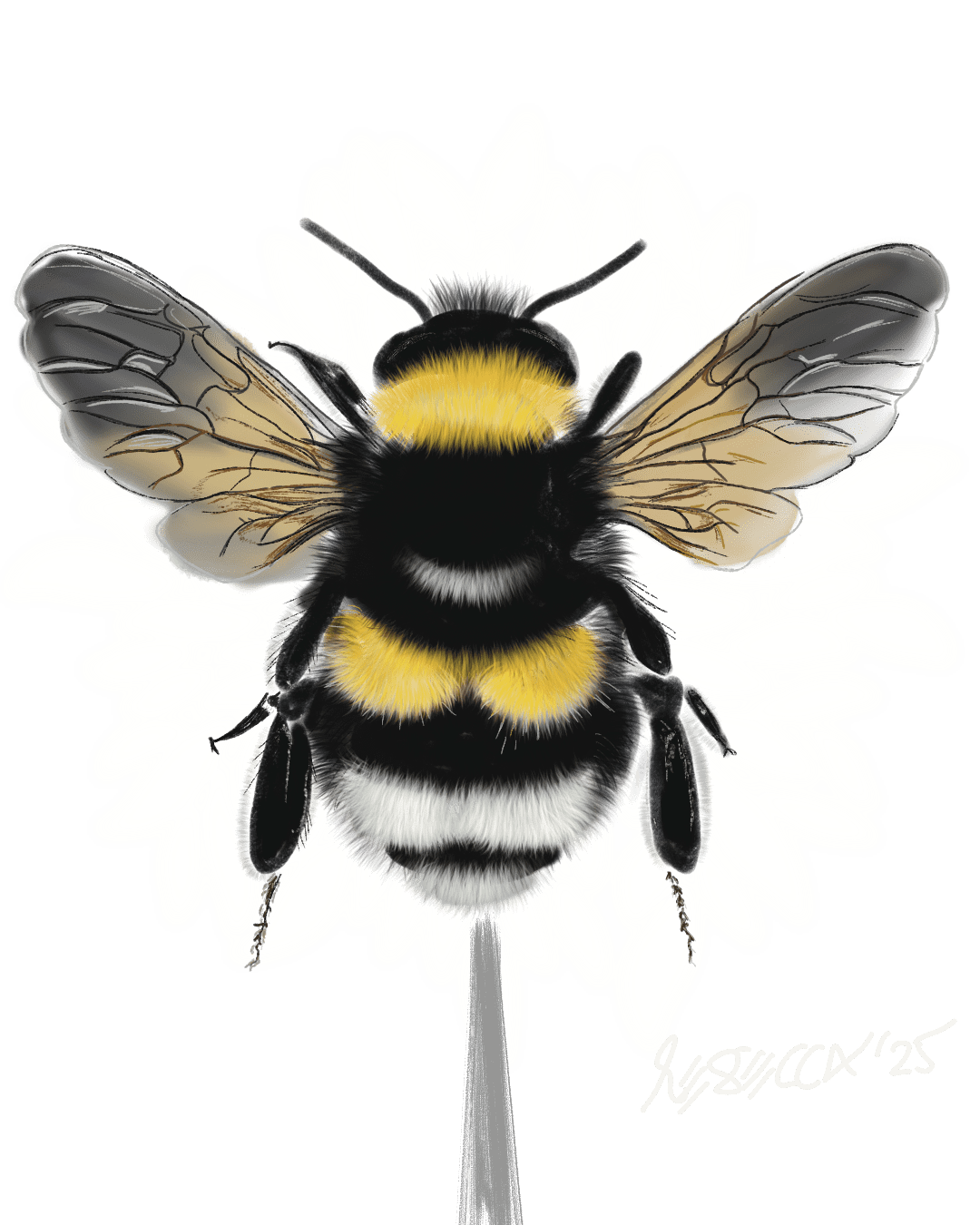
How to Paint a Bee in Digital Art (Without Losing Your Mind Over Fur and Wings)
Have you ever tried painting a bee and ended up with something that looked more like a stripy potato with wings? You’re not alone. Bees are fascinating little creatures, but getting their fine fur and transparent wings right can feel impossible, unless you know a few tricks. Let’s break it down so you can bring your buzzing subject to life in digital art.
Bee Basics – What Are You Actually Painting?
Before picking up your Apple pencil, take a moment to study what makes a bee instantly recognisable.
Bees are covered in fine, pollen-trapping hairs (called setae), giving them that soft, fuzzy look. Their bold black and yellow markings vary depending on the species. The bee in my image looks like a buff-tailed bumblebee (Bombus terrestris), which has creamy, off-white fur on its tail instead of bright white.
Unlike butterfly wings, bee wings are semi-transparent with delicate veins. They have a hint of iridescence but aren’t overly colourful. Their strong, slightly fuzzy legs sometimes collect pollen in specialised structures called pollen baskets. How amazing is that!
How to Paint the Bee’s Wings Without Making Them Look Like Glass
Bee wings need to look thin and light, but they still have structure. The key is making them see-through but not invisible.
Sketch the shape lightly, keeping the curves soft and slightly tapered at the ends. Use a soft airbrush to add transparency, lowering the opacity of your base colour so it blends subtly into the background.
For the delicate network of veins, avoid harsh black lines. A warm brown or greyish tone works best for a natural look. Fine, pressure-sensitive strokes will help create the effect of organic, tapering veins. Experiment with blend modes. Multiply is great for depth, while Overlay adds subtle highlights.
To enhance the reflective quality of the wings, apply a soft wash of pale blues or purples using the Colour Dodge mode. Adding a slight blur to parts of the wings helps create movement, making them feel more dynamic and natural.
How to Paint the Bee’s Fuzzy Body Without Going Fur-Crazy
Bees are covered in dense fur, and getting the texture right makes a huge difference. But don’t worry, you don’t have to paint every single hair individually.
Start with a solid base colour, using black for the dark areas and a warm golden yellow for the stripes. Use a soft round brush to block in the fluff, painting in the direction the fur grows and layering gradually.
If you have a fur brush, that can speed things up, but a simple soft brush with quick, flicking strokes can work just as well. Adding subtle highlights where the light hits and deepening shadows will help create a sense of softness and volume.
The legs need a different approach. The fur is shorter and sparser, so keep the strokes delicate. Less is more here. Too much detail can make the legs look heavy rather than agile.
Real bees have fluffier patches in some areas and sparser ones in others. So, if the fur looks too uniform, break it up by varying the density and direction slightly.
Bringing It All Together
Take a step back and check the overall balance. The wings should be transparent but structured, and the fur should feel soft and natural. Make sure the highlights and shadows are working together to create depth.
If something feels off, don’t stress. Digital art is all about layering and refining. Zooming out or flipping the canvas can help you spot areas that need adjusting.
Final Thoughts
Painting bees is a great way to practise texture, transparency, and attention to detail in digital art. With a mix of soft airbrushing, precise strokes, and good layering, you’ll go from a stripy potato to a realistic, fuzzy bee in no time.
Give it a try, and if you do, I’d love to hear how it goes. As you can see, I’m still learning and never pretend to be an expert or super talented. Every time I pick up my iPad to work in Procreate, or get out my paints and paper, I’m learning.
Keep painting, keep experimenting, and enjoy the process!
 Rebecca Art